



Time and the conscientious objector: to rest with, to wrest with
Time and the conscientious objector: to rest with, to wrest with was a commemorative banner installation for the Saint Francis Catholic Worker House in Chicago, IL, accompanied by a performative lecture on labor and gift economies. | 2015
To rest with,
to wrest with.
To wrest with the impossibility of truth. These hands, this labor, a commemoration of one’s time. This place, the Saint Francis of Assisi House of Hospitality, a home within a home, that is not just a home. Maybe a place to build safety, to build care, to build possibility. Again. Maybe.
Thank you. Thank you. I’d like to give thanks to dear cohorts of the collective Lucky Pierre, for sharing with me the endless value of conversation and friendship. I’d like to thank Joshua Kent for his critical and creative insight in helping to shape this piece and making it what it is. Because it isn’t much without this very space, and the work he and rest provide.
And that’s about time–taking the time, accepting the task, to feed the idea. This is my work. This is our work. This is about what it means to rest with. To feast in much needed slumber. To wrest with. To face the difficulty of not knowing tomorrow. To embrace the gentle sweep of such damaging thoughts, and move on, or remain still.
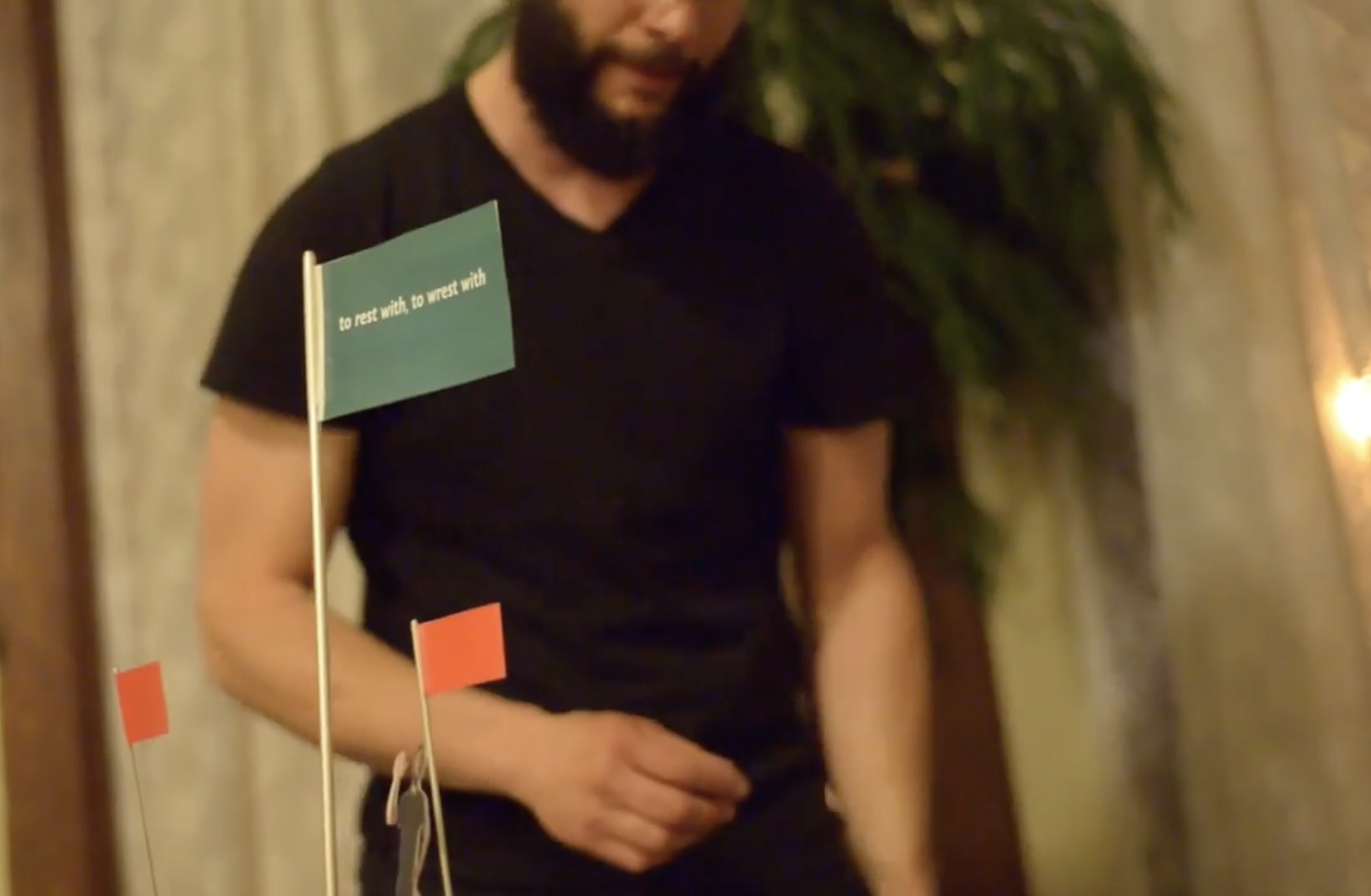
You’ll notice outside in the backyard there is a 15-foot flagpole with an emerald green banner raised, flaunting the text, “To rest with, to wrest with.“ And if you haven’t had a chance to peer out there, I have a smaller version right here. I will not pass this around right now because it will cause a distraction, and I really want you to pay attention to me, not this mockette, if you really want to take a closer look you can do that later or you can just go look at the real thing outside.
So what does it mean to claim that site, this site? What does it mean for the nameless invisibility of it? These words are intended to direct thought toward the honoring of gifted labor, and not the sole emphasis of ownership. This is a complex and difficult task to toil. It is a multifaceted conversation and thought process that involves a complex and disciplined-yet-fluid argument; it requires the possible simplicity of a gesture to be conveyed. So perhaps there is an honoring of independence. A necessary, but momentary independence. Just as temporary as this memorial is to the economy of communal giving, as is the permanence of those individuals who seek out this place. My critique is that we sit in a place, socialist in its value system, and exchange of currencies such as food, conversation; which have not been given notice to any significance or prominence in this country since the very early 20th century.
Who gets solidarity?
Maybe something more than just offering a safe place, a good meal, and some conversation; the things that privilege provides without end. But when privilege is absent? That safety, that conversation and nourishment are seen in different, foggier, distant light. It is my indelible hand that marked that site, temporarily giving claim not of ownership, but that there is in this space some independence. At least, for a while, away from the devastating undocumented tribulations that fall upon those who have sat where you are sitting, eaten, bathed, cried, laughed, wanted more, wanted less, within these walls.
How does one create a gift, a new imaginary for life? How does one replace our current muddled, non-ethical experience for an ethical experience, which one is hyper aware of against this formatted universe? The nature of giving one’s time, to pride the acknowledgement of others that they are appreciated, and that their need and breath is recognized. How is that valued and how is that measured? We are told, and it is embedded in our thinking, that every aspect of our living experience is a transaction. That there is always a monetary value connected to our walking to the train, meeting a friend for coffee, daydreaming, etc, etc... That work and this work has a value. And maybe it should have some kind of monetary value, like 60, 70, 80 dollars per hour. 8, sometimes 10, sometimes 14 hours a day, 7 days a week. Full-time baby! Non-taxable! But most likely it doesn’t have monetary value attached, and in fact it doesn’t. That time doesn’t get what it deserves. There is a different driving force, or forces, that come into play. The very gesture that this place provides is against our hypercapitalist imaginary which systemically propels us away from the idea of care. The idea of why should I care and the even more devastating who the hell are YOU to CARE! That said, this flag also represents the contentious efforts to reframe our ethical structuring, which translates to: we have to do the work. To provide and sustain meaning, there must be some talking, and then some active force as a result.
Beyond hospitality, Catholic Worker communities are known for activity in support of labor unions, human rights cooperatives, and the development of a non-violent culture. Those active in the Catholic Worker Movement are often pacifists; people seeking to live an unarmed life. During periods of military conscription, Catholic Workers have been conscientious objectors to military service. Many of those active in the Catholic Worker Movement have been jailed for acts of protest against racism, unfair labor practices, social injustice, and war.
Time and the conscientious objector.
It is unlikely that any religious community was ever less structured than the Catholic Worker. Each community is autonomous–there is no board of directors, no sponsor, no system of governance, no endowment, no pay checks, no pension plans. Since Dorothy Day’s death, there has been no central leader.
This house was a gift with the intention that it would survive and continue the practices which it implores today. 41 years of redefining the value of excess commodities, such as food. 41 years of saying welcome. 41 years of saying goodbye because it’s not always easy; because this is about us, and you’re making it about you, and we don’t know what else to do right now.. 41 years of the little moments that suddenly recapture a sense of stability. And as much as I could go on about justifying the placement of an emerald banner, hidden away in the Uptown neighborhood of Chicago, there is the part that it is really about me. Me, and my recognition that the unnecessary momentary reciprocity of gifting my time to something is, in fact, very necessary.
And as I speak and glance at this text written an Arial font with its title, Time and the conscientious objector: To rest with, to wrest with, in Arial bold italics because I enjoy its simplicity, readability, and commonality so much. Oh Arial. Your simplistic style juxtaposed to this profundity of actions and work. I feel I have looked for the profound and mundane as an artist to create my foundation for each project, performance, that I have been involved in. And here, we reside in them simultaneously. Just as there is no god, which resides in my confidence of being against the fantastic conviction, which began in the Catholic Worker Movement in humble and incredible faith. Our foundational beliefs are nothing more than contrivances, and we have to work together. I see this need for an intersection here, regardless of any fundamental differences. This is not a crossroads, but an intersection of giving time and valuing that time.
This is about something: it is about the respect of space. Of what we have. Our bodies as spaces-occupied, and the comfort of that occupied space, having access to the recuperating possibilities of a box with an opening, or a room with an entrance and exit. This is about two disparate entities finding a place where they realize they are not so disparate after all.
Collective responsibility.
“Collective responsibility“, as defined in my copy of the Oxford Companion to Philosophy, edited by Ted Honderich, Oxford University Press, 1995. To Jane, Bee, Kiaran, John, and Ruthie. Received by me as a gift from Michael Thomas, thank you. Collective responsibility is “responsibility that can be assigned to some group or organization. A focus on moral blame or punishment, e.g. of the German People for the Nazi Period.“
And I will interrupt here to point out that it always seems like the Nazis get all the credit for damaging humanity, and as they were very fucked up in their intentions to exterminate groups of people, particularly the Jews, in any white-experience-based text the point is never made that white people should be blamed or take responsibility for the detrimental effect of the enslavement of Africans, the destruction this caused to the continent of Africa, as well to other people of color. I just haven’t seen that pointed out anywhere, so please let me know if you have. You can email me at matthew dot donald dot nicholas at gmail dot com, or call me on my cell at three one five, seven three zero, zero three two four.
Anyway, although not exhaustive of this concept, is commonality. In this sense, collective responsibility contributes to the generation of many questions. We can ask, inter alia, about similarities and differences between individual and collective responsibility; whether either one undermines the other, whether either one is preferable in moral assessment in some context. We may particularly ask when there ought to be collective responsibility. Arguably, there should be collective responsibility, as fault, when a group or organization intends or causes harm, and the group or organization has or had the capacity to understand the wrongness of that intention to cause harm, and to modify or avoid these. This account does not fit the no-fault collective responsibility, an enormously important but complex concept which is also indispensable in modern societies.
So, I immediately flipped the pages to the entrees beginning with the letter “n” to find the entry for “no-fault collective responsibility”. There isn’t one in my Oxford Companion to Philosophy, and I was immediately outraged. How could the editor overlook this supposedly enormously important detail? How was there no reference in this book of reference? I will tell you what–he didn’t follow through and he didn’t take the time. You know, maybe Ted’s a great editor, but how do you make a reference and then leave out the entry for that incredibly important subject which is supposed to be a compilation of all the most incredibly important references? Or maybe Ted’s the kind of guy that honestly believes he’s doing the good work. Fighting the good fight, and yet hasn’t the self awareness to recognize his own shortcomings. And then has no ability to see all the people that surround him that are searching and working for more, for something better for themselves. For others. But I don’t know Ted, so I’m just speculating, judging, and projecting.
The last moments of wanting will continue over into the last moments of being.
Here is a picture of the sewing machine that I did not use to make the flag because I gave up after fussing with it for only 5 minutes.
Here is a picture of everyone who is texting right now and not paying attention.
Here is a picture a picture of a Taylor Swift t-shirt that I occasionally walk by displayed in a storefront on Milwaukee Avenue, just north of Central Park Avenue.
Here is a picture of some people who never really wanted anything.
Here is a picture of some people who never really wanted anything to be different.
Here is a picture of some people who changed their mind.
Here is a picture of everyone walking away from one another, never looking back, and never making a sound ever again.